The Morning I Rescued a “Puppy” That Wasn’t a Puppy at All
A Tiny Life Beside the Trail
It was just after sunrise on a quiet winter morning when I noticed something unusual beside a narrow walking trail.
At first, it looked like a small pink shape against the cold ground. I almost walked past it, assuming it was a leaf or piece of litter. But something made me stop and look again.
The tiny creature moved.
Curled tightly into itself, it was no larger than a thumb. Its skin was soft and pink, its eyes completely closed. It trembled so lightly that for a moment I wondered if it was even alive.
My first thought was simple: a newborn puppy that had somehow been abandoned.
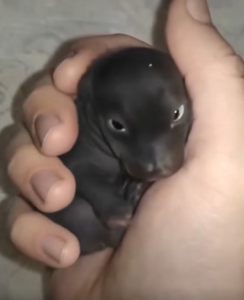
The morning air was cold enough to be dangerous for such a fragile animal. Without thinking much further, I wrapped the tiny body in my scarf and carefully carried it home.
I placed it gently inside a small shoebox lined with cloth and kept it warm with a nearby lamp while I contacted a local wildlife rescue center.
Within the hour, I was on my way there.
A Closer Look at the Mystery Animal
The rescue staff gathered quietly as I opened the box.
Even for experienced animal caretakers, the tiny creature looked surprisingly delicate. It was completely hairless, its eyes sealed shut, and its breathing was slow but steady.
One of the wildlife specialists examined it carefully.
Another made a few phone calls.
After several minutes of discussion, they finally reached a conclusion that surprised everyone in the room.
The animal I had believed to be a puppy… wasn’t a puppy at all.
It was a newborn domestic rabbit, only a few days old.
Baby rabbits are born hairless, blind, and extremely fragile, which explains why the tiny animal looked so unfamiliar. At that age, they are normally kept hidden in carefully built nests where their mother visits only briefly to feed them.
Finding one alone in the open was extremely unusual.
And for a rabbit that young, survival outside the nest is very unlikely without immediate care.
An Unexpected Detail Emerges
Later that same day, the rescue center received an interesting phone call.
A couple who lived nearby explained that their golden retriever had discovered something tiny that morning and gently carried it toward them.
They initially thought the dog had picked up a piece of cloth or a toy and had taken it away without examining it closely.
Only after hearing about the rescue center’s new arrival did they realize something remarkable.
Their dog had likely found the baby rabbit before anyone else—and had instinctively tried to bring it to safety.
Stories of dogs carefully carrying injured or young animals are occasionally reported by wildlife organizations, and the rescue staff believed this may have been one of those rare moments of gentle animal behavior.
The Rescue Team’s Care
The rescue center named the tiny rabbit Willow.
For the next several weeks, Willow required constant attention. Newborn rabbits cannot regulate their body temperature, so she was kept inside a controlled incubator to stay warm.
Every few hours, caretakers fed her carefully using specialized formulas designed for orphaned baby mammals.
For a long time, her survival remained uncertain.
But slowly, signs of progress appeared.
Her skin became stronger.
A thin layer of soft fur began to grow.
Eventually, her eyes opened for the first time, revealing wide blue-gray curiosity.
Each small milestone was a sign that the fragile life found beside the trail was growing stronger.
A Year Later
Nearly a year passed before I returned to visit the rescue center again.
In my mind, I still pictured the tiny pink creature I had wrapped in my scarf.
So when I stepped into Willow’s enclosure, I stopped in complete surprise.
The rabbit hopping toward me was enormous.
Her body was large and powerful, her fur thick and silver-gray. Her long legs and broad build made her look far larger than most rabbits people are familiar with.
The caretakers smiled and explained that Willow was likely a Flemish Giant mix—a breed known for being one of the largest domestic rabbits in the world.
Some Flemish Giants can grow to over 6–8 kilograms (13–18 pounds) and stretch more than 60 centimeters long.
Willow gently nudged my hand as if greeting an old friend.
It was almost impossible to believe she had once been that tiny, fragile life beside the trail.
A Reminder About Small Acts of Compassion
Looking back, Willow’s survival depended on a chain of simple actions.
A dog’s gentle instinct.
A moment of curiosity on a quiet trail.
And a team of trained rescuers willing to care for an animal so small and vulnerable.
Wildlife experts often remind people that many young animals found in nature should be left alone because their parents are usually nearby.
But in rare situations—especially when a newborn animal is clearly exposed, injured, or in immediate danger—contacting trained wildlife professionals can make the difference between life and death.
Willow’s story is a quiet reminder of something simple but powerful:
Compassion often begins with a small decision not to walk past something in need.
And sometimes, those small decisions grow into the most unexpected stories of survival.