How Steve McQueen and Ali MacGraw’s Scandalous Romance Shook 1970s Hollywood
In the early 1970s, few couples embodied Hollywood mystique like Steve McQueen and Ali MacGraw. He was the rebellious “King of Cool.” She was the luminous star of Love Story. Together, they became the era’s most talked-about pairing — equal parts glamour, passion, and controversy.
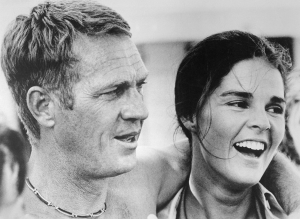
And one photograph from that time still fascinates fans today.
Taken during the filming of Papillon in Jamaica, it shows McQueen and MacGraw in a relaxed, sun-drenched moment.
At first glance, it seems like effortless star chemistry. But history gives the image deeper meaning — because MacGraw wasn’t even in the film.
She was there for him.
A Meeting That Changed Everything
When McQueen asked MacGraw to co-star with him in The Getaway, their connection was immediate. Both were at career peaks: she had just become one of the world’s most recognizable actresses after Love Story (1970), while McQueen dominated box offices with his cool, understated intensity.
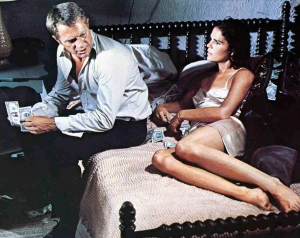
Their on-screen partnership in The Getaway quickly became a real-life romance.
At the time, MacGraw was married to influential producer Robert Evans, making the relationship front-page scandal in an industry still shaped by conservative studio expectations. Yet the pull between the two stars proved stronger than reputation or convention.
By 1973, they married — sealing Hollywood’s most electrifying love story of the decade.
The Wyoming Wedding That Became Legend
True to McQueen’s anti-Hollywood persona, the ceremony was anything but lavish. The couple wed outdoors beneath a cottonwood tree in Cheyenne, Wyoming, in a small park ceremony attended only by their children.
The officiating judge reportedly interrupted a golf game to perform the vows — a detail that perfectly captured the spontaneity surrounding the pair.
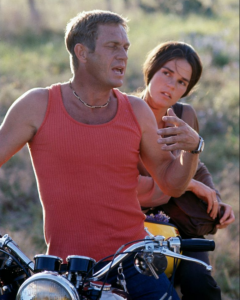
From that moment, McQueen and MacGraw became a cultural symbol: rugged masculinity meeting refined elegance. Their leather-and-denim style, mirrored sunglasses, and unmistakable chemistry defined 1970s celebrity romance.
The Love Story Behind the Image
That famous Jamaica photo from Papillon carries a quiet tension when viewed with hindsight. Their closeness, the almost-touch of hands, the intensity of McQueen’s gaze — all suggest a relationship in full spark.
But their marriage, like many passionate unions, held complexities beneath the glamour.
MacGraw later spoke about struggles balancing her independence with McQueen’s expectations.
He, shaped by a difficult childhood and deep mistrust, reportedly wanted a more traditional domestic life than she ultimately desired.
By 1978, the couple had separated.
Their story transformed from fairy tale to cautionary romance — one that revealed both the magnetism and fragility of star-crossed love.
The Papillon Era and the Oscar Question
McQueen’s performance in Papillon is still widely regarded as one of his strongest. Yet neither he nor co-star Dustin Hoffman received Academy Award nominations for the 1974 ceremony.
At the time, industry observers cited multiple possible factors — from fierce competition that year to debates about casting and McQueen’s anti-establishment reputation. While speculation circulated in Hollywood columns, no single cause for the omission was ever confirmed.
View this post on Instagram
The absence only added to the mystique surrounding both the film and McQueen’s career.
Hollywood Passion That Still Captivates
Today, the McQueen–MacGraw romance remains one of classic Hollywood’s most compelling relationships — intense, stylish, and ultimately fleeting.
That Jamaica photograph endures because it captures more than two celebrities. It freezes a moment when attraction, rebellion, fame, and risk all converged.
A glance.
A near touch.
A love story already changing Hollywood.
And like many legendary romances, its power lies not only in how brightly it burned — but in how briefly.