The Tiny Metal Detail That Changed Workwear Forever: The Real Story of the Jean Rivet
Most people wear jeans every day without a second thought about the small metal studs fixed at the corners of the pockets.
They blend into the design so completely that they seem purely decorative — a familiar part of denim’s identity.
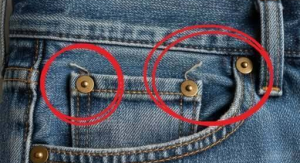
But those tiny pieces of metal were never created for style.
They were created to stop clothing from breaking.
When Jeans Were Tools, Not Fashion
In the mid-1800s, denim was not associated with casual wear or trends. It was practical work clothing worn by miners, railroad laborers, and tradesmen across the American West.
Workers faced a constant problem: pockets tearing under the weight of tools, nails, and equipment.
Even thick denim fabric failed at the seams where strain concentrated. Clothing wore out quickly, forcing laborers to repair or replace garments they depended on daily.
A tailor named Jacob Davis observed the issue repeatedly in his customers’ clothing. He realized the fabric itself was strong — the failure occurred at stress points.
His solution came from outside clothing.
Borrowing Strength from Industry
Davis adapted a fastening method already used in heavy materials: copper rivets.
By pressing small metal rivets into the corners of pockets and other high-tension areas, he distributed force across a wider surface instead of letting strain pull on a single thread line.
The change was simple — and transformative.
Pockets stopped tearing.
Clothing lasted longer.
Workers trusted the garments.
The 1873 Patent That Defined Denim
Recognizing the importance of the invention, Davis partnered with fabric supplier Levi Strauss to secure a patent in 1873 for rivet-reinforced work pants.
The goal was practical durability, not branding or fashion.
Early riveted jeans placed metal studs in multiple locations, including back pockets and near the fly.
However, feedback from horse riders soon revealed a new issue: exposed rivets scratched saddles and furniture. Manufacturers responded by modifying placement and covering certain rivets.
From the beginning, design decisions followed real-world use.
Why Rivets Still Exist Today
Modern textile engineering and reinforced stitching can now achieve similar strength without metal. Many contemporary jeans omit rivets entirely.
Yet countless denim makers continue to include them.
Not simply for tradition — but because the original function still matters.
Movement, bending, and carrying weight continue to place stress on the same points in garments today as in the 1800s.
The rivet remains an elegant engineering solution: small, durable, corrosion-resistant, and mechanically efficient.
A Hidden Lesson in Everyday Design
The rivet’s story reflects a broader principle seen across durable objects:
The most enduring design elements often begin as solutions to real problems.
Over time, users may forget the original purpose — but the feature survives because it works.
Jeans evolved from workwear to global fashion, yet the tiny metal reinforcement stayed embedded in the garment’s DNA.
Many people now feel jeans look incomplete without it, even when stitching alone would suffice.
Function quietly became identity.
More Than Decoration
Those small metal points hold where fabric would otherwise fail.
They spread stress, protect seams, and extend garment life — exactly as they did more than 150 years ago.
So when you wear jeans, you’re not just wearing a style.
You’re wearing a practical innovation — refined through use, preserved through effectiveness, and passed down across generations of clothing design.
Sometimes progress doesn’t erase what came before.
It keeps what was built wisely.
And sometimes the strongest details are the smallest ones — the ones we only notice when they’re missing.