Visible Protests Erupt as Democrats Defy Leadership’s Call for Restraint During Trump Address
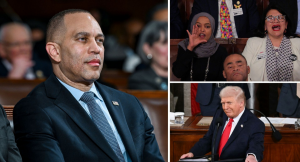
A night intended to showcase presidential priorities instead highlighted deep political divisions inside the U.S. Capitol.
During a high-profile congressional address by Donald Trump, several Democratic lawmakers staged visible protests, interruptions, and walkouts — despite prior appeals from party leadership to avoid disruptions.
The result: one of the most openly confrontational speech atmospheres in recent memory.
Leadership Urged Calm — Events Took a Different Turn
Ahead of the address, Hakeem Jeffries had encouraged Democratic members to maintain a restrained posture if they chose to attend, emphasizing contrast rather than confrontation.
But once the speech began, tensions quickly surfaced.
Some lawmakers remained seated during applause lines.
Others held signs or displayed symbolic messages.
Several exited the chamber mid-speech.
The coordinated restraint leadership hoped for did not fully materialize.
Early Disruption Set the Tone
One of the most visible incidents occurred near the opening moments, when Representative Al Green was escorted out after displaying a protest sign from the chamber floor.
The removal drew immediate attention in the hall and across live broadcasts, signaling that the evening would not follow traditional decorum.
Walkouts and Shouted Responses
As the address continued, additional lawmakers left their seats or exited entirely during policy sections they opposed.
At several points, vocal objections could be heard from Democratic members responding to presidential remarks, adding to the charged atmosphere.
Moments of bipartisan applause still occurred — particularly during references to military service members and invited guests — but they were interspersed with visible partisan resistance.
Symbolic Messaging Inside the Chamber
Beyond verbal reactions, some Democratic attendees used clothing, pins, or invited guests to signal policy disagreements, a tactic increasingly common in modern congressional addresses.
Such symbolic protest has become a way for lawmakers to communicate dissent without formal floor debate during televised events.
A Speech Framed by Polarization
Trump’s address itself maintained a combative tone at times, contrasting his administration’s policies with those of Democrats and criticizing opposition positions.
That rhetorical style, combined with organized Democratic dissent, created a feedback loop of reaction and counter-reaction inside the chamber.
Observers noted that the atmosphere reflected broader national polarization more than any single policy dispute.
Aftermath: Competing Narratives
Following the speech, party leaders offered sharply different assessments.
Jeffries criticized the address and its tone.
Ilhan Omar and Rashida Tlaib unravel into screeching rage as Trump declares US government should put Americans first before illegals pic.twitter.com/qVTzHcjXRh
— Benny Johnson (@bennyjohnson) February 25, 2026
Is Rashida Tlaib chanting “KKK” while everyone else chants “USA”? Sure looks like it pic.twitter.com/5nnp0or3Xn
— Matthew Foldi (@MatthewFoldi) February 25, 2026
Republicans highlighted Democratic disruptions as evidence of partisan hostility.
Supporters of each side amplified clips aligning with their interpretations.
The evening quickly transitioned from legislative messaging to political narrative.
A Sign of the Times in Washington
Presidential addresses to Congress have long included partisan tension.
But visible protest within the chamber has grown more common in the modern media era, where brief visual moments can define public perception of an entire speech.
This address illustrated that shift.
Policy proposals were delivered.
Political contrasts were drawn.
Yet the images that traveled farthest were those of dissent — signs held, lawmakers leaving, voices raised.
In today’s political communication landscape, symbolism often competes with substance for attention.
And on this night, both were impossible to ignore.