How Social Media Is Reshaping Political Messaging in the U.S.
In today’s digital landscape, political communication no longer follows the same rules it once did.
What used to be delivered through formal speeches or carefully written statements is now often shared instantly—sometimes in just a few lines or a single image.
And in many cases, the reaction to those posts becomes just as important as the message itself.
A New Style of Communication
Few figures have embraced this shift more visibly than Donald Trump.
Throughout his public career, his use of social media has stood out for its directness and speed.
Posts often include short statements, reposted content, or visual elements that are designed to capture attention quickly.
This approach is not accidental. It reflects a broader strategy that blends messaging with visibility—aiming to reach audiences in a format that feels immediate and widely shareable.
Moments That Spark Conversation
Recent posts, including those referencing public figures such as Barack Obama, have once again highlighted how tone and presentation can shape the conversation.
In some cases, these posts draw on past political moments or statements, presenting them in a simplified or stylized way.
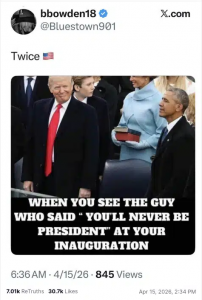
This is common in online communication, where complex ideas are often condensed into short, impactful formats.
While the details may sometimes be streamlined for effect, the response they generate tends to be anything but simple.
Different Perspectives, Strong Reactions
As with many forms of modern political messaging, reactions often vary widely.
- Supporters may view this style as confident, engaging, or even refreshing in its directness.
- Critics may see it as overly personal or less aligned with traditional expectations of public office.
This contrast is part of what gives such posts their reach, they invite interpretation and discussion from multiple sides.
Where communication once emphasized formality and structure, it now often prioritizes speed and engagement. Topics that might have taken days to unfold can now spark widespread discussion within hours.
At the same time, this environment can blur the line between information and interpretation, making it more important for readers to approach content thoughtfully.
Moments like these are not only about the content itself—they also reflect how people interact with it.
They highlight how audiences respond, how narratives form, and how quickly attention can move from one topic to the next.
In that sense, the real impact goes beyond any single post. It lies in how these exchanges shape the broader conversation.
As social media continues to influence how public figures communicate, understanding the context behind the message becomes just as important as the message itself.
Because in a fast-moving digital world, clarity and perspective remain essential.