Trump Draws Attention After Sharing Symbolic AI Image Following Remarks on Pope
Donald Trump is once again at the center of online conversation—this time following a social media post that combined political messaging with symbolic imagery.
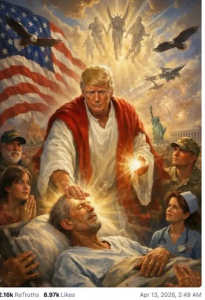
The post, shared on his platform Truth Social, featured an AI-generated illustration that immediately drew attention for its visual style and timing.
The image depicted Trump in flowing robes, standing beside a patient in a hospital bed, with visual elements that many viewers associated with traditional religious artwork.
Figures in the background—including a doctor, a woman in prayer, and a uniformed individual, appeared to observe the scene. Additional imagery, such as recognizable American landmarks and symbols, added another layer of interpretation.
Notably, the post did not include a caption, leaving its meaning open to discussion.
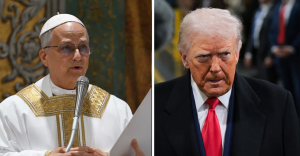
The post followed shortly after Trump publicly criticized Pope Leo XIV over positions related to international issues.
While public figures often exchange criticism, the combination of political remarks and symbolic imagery intensified the reaction across social platforms.
Observers noted that the sequence of events contributed significantly to how the post was received.
As with many of Trump’s online posts, reactions were immediate and varied.
Some critics argued that the imagery was inappropriate due to its resemblance to well-known religious themes.
Others expressed concern about the blending of political identity with symbolic or spiritual representation.
Supporters, however, viewed the post differently—some interpreting it as satire, while others saw it as a form of expressive or symbolic communication consistent with Trump’s style.
This is not the first time Trump has shared stylized or AI-generated imagery. In the past, similar posts have portrayed him in various symbolic or exaggerated roles.
Such content often sparks conversation because it blurs the line between humor, commentary, and messaging—especially in a digital environment where visuals can travel quickly and be interpreted in many ways.
Moments like this raise broader questions about how public figures use imagery in the modern media landscape.
With AI-generated visuals becoming more common, the boundaries between satire, symbolism, and serious messaging are less defined than ever.
For audiences, interpretation often depends on perspective.
Whether viewed as provocative, symbolic, or simply attention-grabbing, the post underscores one consistent reality:
Donald Trump continues to generate discussion—not only through what he says, but through how he chooses to present it.
And in today’s digital space, that combination can be just as impactful as words alone.