Most People Get This Viral Riddle Wrong At First
A simple riddle has once again captured the internet’s attention, leaving thousands of people second-guessing themselves before realizing the surprisingly easy answer.
At first glance, the puzzle seems straightforward. It introduces a woman named Penny who has five children.
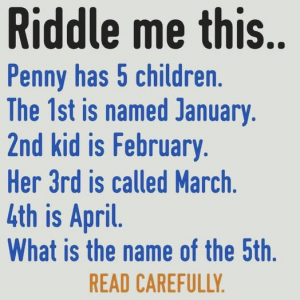
The first four are listed as January, February, March, and April — leading many readers to immediately assume the fifth child must also follow the pattern of months.
But that’s exactly where the trick begins.
The riddle reads:
“Penny has 5 children.
The 1st is named January.
2nd kid is February.
Her 3rd is called March.
4th is April.
What is the name of the 5th?”
Most people quickly jump to “May” because the names follow the calendar. However, the question asks readers to pay close attention to the wording.
The answer is actually much simpler.
The fifth child’s name is “What.”
Why? Because the final sentence says: “What is the name of the 5th.” It’s written as a statement rather than a question with a question mark, making “What” the intended name.
This type of brain teaser is designed to test attention to detail rather than intelligence.
Similar riddles often go viral online because they encourage people to react quickly before carefully rereading the wording.
Social media users frequently share puzzles like this because they create instant engagement. Some readers immediately spot the trick, while others confidently give the wrong answer before realizing the hidden wording.
Part of what makes riddles like this so entertaining is how they challenge the brain’s natural tendency to recognize patterns. Once people see January, February, March, and April, the mind automatically expects May to come next.
But the real challenge lies in slowing down and carefully reading every word.
In recent years, short riddles and visual puzzles have become increasingly popular across Facebook, TikTok, and other social media platforms because they encourage comments, debates, and shares among friends and family.
For many people, solving a clever riddle provides a small but satisfying mental reward — especially when the answer turns out to be hiding in plain sight all along.